Sunday, April 28, 2013

Review of The Unbearable Lightness of Being by Milan Kundera

"The novel is not the author's confession; it is an investigation of human life in the trap the world has become." -TULOB

1988 film adaption (not as good as the book, naturally)
The Unbearable Lightness of Being explores the lives of four characters trapped by the totalitarian Soviet regime in 1960s Prague. 
Tomas is a Czech surgeon, who seems to view women as a hobby, and is later demoted to a career as a window washer after publishing a though-provoking, although abbreviated, article on the connections between the story of Oedipus and the oppression of Communism.
Tereza, Tomas's shy wife,  protests the Soviet occupation by taking evocative photographs. She is forever trapped by her jealousy of Tomas's continuous affairs with other women.
Sabina, Tomas's lover and best friend, an open-minded painter who symbolizes the artist figure under totalitarian Soviet rule.She eventually relocates to Switzerland, then New York, and finally California. She best embodies "lightness" in the novel as she learns to embrace "beauty by mistake" after accidentally dripping red paint on one of her best paintings.
 Franz, Sabina's naive lover,  is completely isolated by his life in academia as a professor in Geneva, but  his break with Sabina prompts him to leave his comfort zone and travel to Cambodia and Bangkok, where he is fatally wounded.
And lastly, but not least, there is Karenin, Tomas and Tereza's dog, who symbolizes man's enduring yet rare ability to love unconditionally in an otherwise corrupt and cruel world.

What I liked best about this novel was how it revealed its characters' thoughts and actions in slivers and traces. Kundera does not bog down his readers with a lot of pointless background information or history; in fact, Kundera barely explains enough for us to understand why characters act in certain ways. Why is Tomas a womanizer? Why is Sabina a painter? What draws and keeps Tomas and Tereza together? Perhaps these unanswered motivations act as a testimony to the randomness that sculpts each and every one of us.

Another unique aspect of this novel which mirrors our current world is the novel's discussion of many philosophical and intellectual theories, which are braided throughout the narrative.  Kundera examines Nietzsche, existentialism, and the impact of totalitarianism on self-expression. In fact,  I even learned a new word: kitsch, which is a word describing the style of artwork meant to glorify and serve the aims of an authoritarian government. The picture to the left is kitsch because it is meant to show the bounty and health of North Korea's Communist regime. Kundera describes the spirit of kitsch in the novel, “everything that infringes on kitsch must be banished for life: every display of individualism … every doubt … all irony (because in the realm of kitsch everything must be taken quite seriously)”. Thus, the style of kitsch is unironic. Kitsch is propaganda and therefore restricts all creativity. 

While Kundera's novel takes place in 1968 occupied Prague, I couldn't help but make connections to my world today.  In what ways do we restrict our own personal freedoms? How often do we allow societal restrictions and expectations to define beauty and art for us, instead of exploring and creating art on our own? These expectations (mirrored by kitsch, propaganda, stereotype or sentiment) are the "weight" the novel's title symbolizes. Perhaps we self-impose such stiffing restrictions on ourselves because the randomness and "beauty by mistake" of our world is just too overwhelming to navigate. 

Sunday, April 21, 2013

Review of Leaving the Atocha Station by Ben Lerner


At first, I found this novel's protagonist incredibly annoying, a literary reincarnate of Holden Caulfield: a young man obsessed with  his own fraudulence. Set against a beautifully rendered culture and landscape, meet Adam, a poet who has been awarded a fellowship to study in Madrid and to supposedly write poems reflecting Spain's political histories.

But what sold me on this narrator was this confession within the novel's first few pages: "I tended to find lines of poetry beautiful only when I encountered them quoted in prose, in the essays my professors had assigned in college, where the line breaks were replaced with slashes, so that what was communicated was less a particular poem than the echo of poetic possibility. Insofar as I was interested in the arts, I was interested in the disconnect between my experience of actual artworks and the claims made on their behalf; the closest I’d come to having a profound experience of art was probably the experience of this distance, a profound experience of the absence of profundity." Adam's perception here was riveting to me in that while questioning the conditions necessary for a "profound experience of art," he was in fact creating one of his own, albeit with a change in media.  While purists might scoff at the effectiveness of poetry when quoted in prose, I appreciated and understood Adam's perspective.

But does Adam research or work on his intended project while in Madrid? No, not really, and he does not seem to care. He wanders between lukewarm love affairs, eats too many little yellow and white pills, and drinks too much coffee and too much wine. He only starts to scribble furiously in his notebook after being questioned by one of his lovers, and this initial scribble is merely a show in which he wishes to prove to her his supposed seriousness as a poet. Throughout most of the novel, Adam seems ashamed to embrace his role as an artist and poet and instead tortures himself by over-thinking the smallest gestures, mistranslations and human interactions and how they reflect his  inadequacies.

Thus, ironically and unbeknownst to Adam, his constant self-consciousness embodies the essential essence of his artistry. What artist ever finds complete satisfaction in his process? It isn't until the very end of the novel when Adam's close translator-friend asks, "When are you going to stop pretending that you’re only pretending to be a poet?” This question and his indecision whether to leave or stay in Spain  prompts Adam to begin to exchange the inhibitions of his self-consciousness for the joy that creativity and collaboration can bring him.  He learns the poet can never truly be isolated.

Overall, Adam's journey made me question the ways in which we are all trapped by our own battles with self-consciousness, especially in today's over-documented hyper-reality. As Adam reads the paper after a terrorist attack near his apartment, he questions, "I could feel the newspaper accounts modifying or replacing my memory of what I’d seen; was there a word for that feeling?"  Thus, when does our self-consciousness inhibit us, and when do we begin to embrace it as part of an authentic experience we share?

Thursday, April 18, 2013

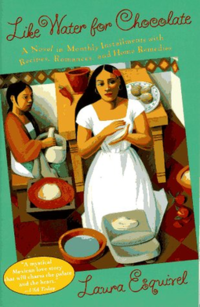
Review of Like Water for Chocolate

Who doesn't love to fantasize about good food? Homemade? Bursting with the spices and flavors plucked and prepared by hand? Quail with Rose Petals never sounded so appetizing, and I'm a vegetarian!

This Mexican romance is told in the traditional magic realist style and incorporates more than twelve authentic  recipes into its plot and underlying themes.  Meet Tita, the youngest daughter of the authoritarian Mama Elena.  Shortly after her birth Tita is raised in the kitchen and thus learns the healing, seductive, and supernatural arts of the kitchen from the family cook Nacha. According to Mama Elena and her cruel version of the family tradition, Tita is forbidden to marry and must instead devote her life to caring for the aging, petualnt Mama Elena. So when Tita and Pedro fall madly in love, Mama Elena quickly marries off Pedro to Tita's sister Rosaura. Pedro only agrees so that he can insure he is always close to Tita. So, Tita must cook, clean, and care for the family, while being denied her basic human freedoms and desires (I mean, really, the love of her life living in the same house but married to her sister?!). But when Rosaura and Pedro's young son dies suddenly,  a domino effect of change cascades upon the De La Garza family.

Tita's creativity, love, and self-preservation reveals the deeper theme of the importance of exercising one's passions.  Tita must question futile family traditions while  upholding the important ones of the family's kitchen, as her sisters neglected to learn the culinary arts.  Tita's struggle to care for a family that does not understand or appreciate her efforts mirrors the challenges of commitment that many young people face to this day,  as one must learn to negotiate personal fulfillment with sustaining meaningful familial bonds.

Esquivel's writing style reminds me of mythology: simplistic and succinct in its selection of details while providing a deeper symbolic resonance in its comedy and tragedy of Tita's supernatural ability to infect her dinner guests with her emotions through the food she prepares. Overall, the novel explores how we are all more connected by the things we share and enjoy (good food!) yet too easily influenced by our more selfish desires. Tita shows us how to strive towards balance and still live a fulfilling life.

Sunday, April 14, 2013

Teaser Tuesday (but it's Sunday...)

  • Grab your current read.
  • Let the book fall open to a random page.
  • Share with us two (2) “teaser” sentences from that page.
  • You also need to share the title of the book that you’re getting your “teaser” from … that way people can have some great book recommendations if they like the teaser you’ve given! 
from "A Few More Don'ts"
http://www.poetryfoundation.org/poetrymagazine/     Ezra Pound set forth his now-famous "A Few Don'ts by an Imagiste" in the March 1913 issue of Poetry.  In commemoration we've asked a few writers to updated Pound's Essay for our time. 


from Sina Queryas's "Tightrope":

       "If, on a snowy night, you find yourself feeling like you are                             inside a Robert Frost poem

        and are moved to write, know that you are feeling move to write
        the poem Robert Frost already wrote.

If, on a crowded street you find your thoughts walking ahead of you,
at a steady pace,

as if they have never been known by you,

you are probably writing your own poem." (47)

I really like this list poem, first off, because it's about writing poetry, and secondly, because it has a clever sense of humor.  The students have me thinking about the difference between plagiarism and imitating established poets, and while I have no answers, I revel in the debate itself.  Above, Queryas reminds us, as Pound would, that the purpose of art is to make something new again. Just appreciating the beauty of a thing isn't enough.  Make it new. Just as the last line of Queryas's poem reads, "Sometimes a poem is just a tweet," but who said a tweet can't be a poem too? Make it new, (you'll have more followers that way too).
                                         

Wednesday, April 10, 2013

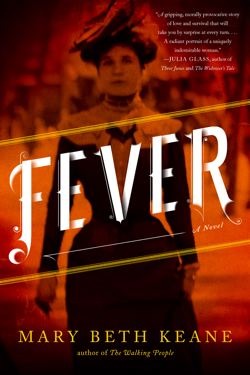
Review of Fever by Mary Beth Keane

FeverThis was a good historical fiction read providing a complex portrait of a woman victimized by her class, ethnicity, gender, and circumstance, but overall, I felt the novel's story lacked momentum. Known today as "Typhoid Mary," the novel's protagonist Mary Mallon was an Irish immigrant living in New York City in the early 20th century who unknowingly spread the disease of Typhoid Fever to the upper class families she worked for as a server and cook. During this time period, people knew very little about diseases and how they were passed, least of all Mary, who is completely caught off guard by these ridiculous-sounding accusations about the deadly effects of her cooking. Mary and the general population at this time simply did not have the education to understand how germs are passed.  In the novel, Keane imagines Mary's daily experiences before and after she is quarantined by the City of New York public health officials. The story does attempt to capture Mary's struggle of her trying to "make it" in America as an independent woman during this time. After four years pass for Mary on her quarantined island, during which she receives minimal  help or affections from her friends or lawyer, it seems impossible that she will ever again support herself. At times the back story (and weak romance sub plot between Mary and her drunken lover Alfred) lacked spark and felt contrived. This romantic subplot seemed more like an opportunity to give Mary's character something else to do  than provide an accurate or interesting addition to the story's main conflict, Mary's forced confinement on a quarantined island. After reading the novel,  I did walk away feeling as though I now have a more complex understanding of this woman's perseverance and the realities of how the Irish working class and single women were discriminated against during this time. I rate this novel 3/5 stars and would recommend it to readers interesting in the history of public health,  Irish immigration to America, or tales about strong, heroic women.

Thursday, April 4, 2013

My 4th quarter reading goal is to read more new poetry.  Usually I find new poetry by stumbling upon it, a friend shows it to me, it's linked online from another source, or I'm exposed to it through a class. This quarter I want to read more new poetry on my own. As I find more new poetry, I plan to share it with you here. Also, as part of National Poetry Month this April, I'm tweeting one of my favorite poems each day.  So far, here's what I've shared with the world:

April 4: Introduced students to the DEAR POETS PROJECT today. We read Arthur Sze's "Comet Hyakutake"

April 3: One of my favorite poems to share with students...

April 2: "I Go Back to May 1937" by Sharon Olds

 April 1: Happy Natl Poetry Month! Here's another fav from Dean Young:  

April 1: Happy Natl Poetry Month! Here's a good one: #1poem140

March 31: Happy Easter! Not April yet, but my fav poem of the day: One of Betsy Wheeler's Non-Sonnets:

March 30: Not April yet, but my fav poem of the day:  

March 29: Can't wait! To honor natl poetry month, I will post a fav poem each day. Kay Ryan's "Eggs":