In "The Family of Little Feet," I feel Esperanza is once again talking about more than feet, and instead is offering up a gritty fable, a poetically un-poetic coming of age story. Little girls Nenny, Lucy, Rachel and Esperanza experiment with fashion and femininity to realize the world is a darker place where sex is traded for money, and feminine dress can be viewed as shameful and not just expressive. After the hobo incident, Esperanza says, "We are tired of being beautiful" (42). These young girls are at an age where they can delay the double standards of sexuality and female objectification; however, now they are aware of the innocence they must trade for their approaching womanhood.
Saturday, February 28, 2015
Response to "The Family of Little Feet"
I was so surprised on Friday when the majority of my students discussed their distaste for Esperanza's negativity and self-consciousness. They see her as constantly complaining about her looks, her name, her feet, her hair. But to me, Esperanza's language is always layered and symbolic. She might be describing her hair on the surface, but what she's really describing is her love for her mother ("Hairs.") While she might seem displeased with her name, what she's really attempting to negotiate is her heritage as a Latina American ("My Name").

In "The Family of Little Feet," I feel Esperanza is once again talking about more than feet, and instead is offering up a gritty fable, a poetically un-poetic coming of age story. Little girls Nenny, Lucy, Rachel and Esperanza experiment with fashion and femininity to realize the world is a darker place where sex is traded for money, and feminine dress can be viewed as shameful and not just expressive. After the hobo incident, Esperanza says, "We are tired of being beautiful" (42). These young girls are at an age where they can delay the double standards of sexuality and female objectification; however, now they are aware of the innocence they must trade for their approaching womanhood.
Tuesday, February 24, 2015
"Where I'm From" after George Ella Lyon
I am from the sandy litter that sticks
to the linoleum and then
to the bottom of my feet and
wet whiskery kisses (don't bite!) at three a.m.
I am from the salt of the icy streets
the absurd cold
whose welcome wore out long before
any memory of leafy greens lining clear sidewalks.
I’m from the Knapp Hill and Wichita Falls,
steaming potatoes served at every meal
and sometimes spicy chili.
From my granddad’s flat feet
and my mother’s worry,
and the insanity my father pleads to keep from going hungry.and my mother’s worry,
I’m from Keebler chocolate Elves
and TV dinners and thick bifocals.
I’m from Roald Dahl’s giant peach,
and Rowling’s School of Witchcraft and Wizardry.
I’m from audio books and paperbacks
and pictures books and chapter books.
From fiction, biography, action and adventure,
and philosophy.
I'm from hard covers and library fines and
From fiction, biography, action and adventure,
and philosophy.
I'm from hard covers and library fines and
dog-eared corners and tissues marking the page
because just like food
nourishes the body,
stories nourish my soul.
I used to have an old saxophone.
Now, somewhere, she rests in a case,
scattered with dry, brittle reeds,
in her a mausoleum of sound,
her growling blue notes muted and impatient.
I am from pieces that fit—
and pieces that strike against each other
to make fire, and warmth
and destruction and memory.
Thursday, February 19, 2015
Response to "My Name"
------
Journal #2, inspired by "My Name" - rough draft!
My mom lost. No, my father would not agree to name me Lucy. That was a name for a Peanuts character and later our first dog, a runty beagle who left warm yellow spots in each corner of the kitchen and who we eventually returned to the pound. As a teenager, there were definitely times I wished I could have been just as easily been returned and therefore freed from my family, but instead, my name has always shackled me, more so than most, to my father. I hve received duplicates of his AARP cards in the mail since I was 19.
But still, my mother argues, JamieAnna, my full name, my true given birth-certificate certified two-part name staring with a 'J' is an homage to my granny, JimmyJoy.
JimmyJoy grew up in Oklahoma, out of tumbleweed and dust, where she left behind an older sister, Wanda, for a secretary job in Texas. She shut the door behind her with only suitcase and an itching left ring finger.
And the story goes that the first of JimmyJoy's four marriages was maybe for love, or was it the second, to my mom's father, the handsome trumpet player? Definitely not the third, a scraggly drunk of a guy who sent a shotgun bullet into the headboard of the heirloom bedframe my mom still sleeps under today. And finally, my granny's final last name, froze on number 4, Content, the surname of a colonel. And today, at 88, Granny's just plain old granny and thank God husbandless, and she tells me that about marriage, you must be coldblooded.
Today it's rare to find woman a woman carrying two first names. You don't see any PollyAnnas or MaryBeths running business meetings or directing films. And over time and convenience, my own name's slimmed down to Jamie, and my full first name remains intimate, spoken to me only by cousins best known during childhood and of course, old grannies who know what I ought to be doing with my life.
Monday, February 2, 2015
January 2015
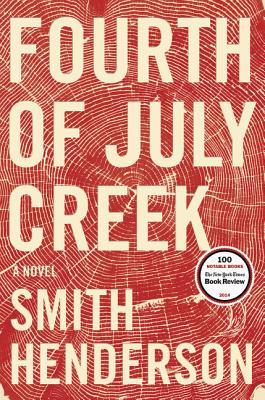
Fourth of July Creek by Smith Henderson
"...the world is a blade and dread is hope cut open and spread inside out."
This is by far the best book I've read in quite a while because of the original plot, flawless prose and structure, and the questions it asks regarding charity, freedom, and social responsibility.
The protagonist Pete is by no means a great social worker; in fact, he is mediocre bordering on pathetic. While his intentions are good, he is blind to the needs of his own family, a wife who has left him and a teenage daughter thirsty for love and acceptance. A modern American novel wouldn't be complete with a a tinge of paranoia and anarchy, so Pete meets Benjamin Pearl and his son. Pete is introduced to the Pearls when he is called to a nearby elementary school where the boy has wandered in, dirty and catatonic with signs of scurvy and malnutrition, and appears to have been living in the woods indefinitely. Thus, Benjamin Pearl's goal is to take down the government, or at least live apart from it, which become one and same. Pete is entangled in Pearl's drama because of his tragic big heart, and soon finds himself in danger. The novel begs us to consider how members of a community can best serve one another while preserving individual dignity.
Inherent Vice by Thomas Pynchon
"What goes around may come around, but it never ends up exactly the same
place, you ever notice? Like a record on a turntable, all it takes is
one groove's difference and the universe can be on into a whole 'nother
song."
Simply read this to prepare for the movie. I've never read any Pynchon, but I appreciated the style, pop culture references, and overall bizarre narration. This novel describes a turning point in American pop culture as the sixties end and the seventies begin.
We Are Not Ourselves by Matthew Thomas
This one was difficult due to the content (suburbia, marriage, Alzeimer's), and I found the prose itself boring and needlessly slow-paced. I did enjoy the very beginning (first 100 pages?) depicting Eileen's childhood growing up in 1950s New York to 1st generation Irish immigrant parents. While adult Eileen is a realistic character, there is little to like about her. While likability doesn't usually 't stop me from enjoying a work of fiction, Eileen simply got on my nerves! She seemed more like a symbol of the dissatisfied American consumer than an actual individual human begin. Her husband Ed and son Connell are more sympathetic characters, and their relationship has bits of truth and humanity. Probably one of the best aspects of this novel is that it deals with the evolution of the American Dream, and while these themes are important, albeit obvious, the story itself was difficult to invest in.
"...the world is a blade and dread is hope cut open and spread inside out."
This is by far the best book I've read in quite a while because of the original plot, flawless prose and structure, and the questions it asks regarding charity, freedom, and social responsibility.
The protagonist Pete is by no means a great social worker; in fact, he is mediocre bordering on pathetic. While his intentions are good, he is blind to the needs of his own family, a wife who has left him and a teenage daughter thirsty for love and acceptance. A modern American novel wouldn't be complete with a a tinge of paranoia and anarchy, so Pete meets Benjamin Pearl and his son. Pete is introduced to the Pearls when he is called to a nearby elementary school where the boy has wandered in, dirty and catatonic with signs of scurvy and malnutrition, and appears to have been living in the woods indefinitely. Thus, Benjamin Pearl's goal is to take down the government, or at least live apart from it, which become one and same. Pete is entangled in Pearl's drama because of his tragic big heart, and soon finds himself in danger. The novel begs us to consider how members of a community can best serve one another while preserving individual dignity.Inherent Vice by Thomas Pynchon
"What goes around may come around, but it never ends up exactly the same
place, you ever notice? Like a record on a turntable, all it takes is
one groove's difference and the universe can be on into a whole 'nother
song."
Simply read this to prepare for the movie. I've never read any Pynchon, but I appreciated the style, pop culture references, and overall bizarre narration. This novel describes a turning point in American pop culture as the sixties end and the seventies begin.
We Are Not Ourselves by Matthew Thomas
This one was difficult due to the content (suburbia, marriage, Alzeimer's), and I found the prose itself boring and needlessly slow-paced. I did enjoy the very beginning (first 100 pages?) depicting Eileen's childhood growing up in 1950s New York to 1st generation Irish immigrant parents. While adult Eileen is a realistic character, there is little to like about her. While likability doesn't usually 't stop me from enjoying a work of fiction, Eileen simply got on my nerves! She seemed more like a symbol of the dissatisfied American consumer than an actual individual human begin. Her husband Ed and son Connell are more sympathetic characters, and their relationship has bits of truth and humanity. Probably one of the best aspects of this novel is that it deals with the evolution of the American Dream, and while these themes are important, albeit obvious, the story itself was difficult to invest in.
Subscribe to:
Comments (Atom)