Wednesday, July 29, 2015

In the Woods (preparing for book talk)

In the thriller In the Woods by Tana French Dublin detectives Adam Ryan and Cassie Maddox are attempting to solve the murder of tweenage ballet prodigy Katy Devlin, who was found dead near her home, and near the wood, on an archaeological digging site. The site is of historians' interest because ancient druids of the region had made human sacrifices at the exact spot Katy's body is found.  Coincidentally, Adam Ryan, now Rob, grew up in this neighborhood, and was involved in a now cold case from 1984: his two best friends disappeared and Adam was found catatonic, with bloody,slashed clothes.  Ryan doesn't remember a thing, and wants to keep his involvement in the seemingly related case secret from his boss and the police. Only his partner Cassie, whom Ryan shares a complicated platonic relationship, knows the truth.  Is Ryan jeopardizing the new case by keeping his connection under wraps? Or is Katy's death completely unrelated?
Immediately, I am suspicious of Adam as I read. His lack of memory for what happened that summer day in 1984 seems too convenient, especially now with a fresh dead body found at the same location.  Adam's partner Cassie doesn't seem suspicious of him, but is this French's misdirection as a master of writing mystery and thriller? Also, Adam isn't the most confident character and frequently drops hints of his lack of insight at the time of Katy Devlin case, showing he admits his spaciness, and perhaps is even alluding to his own guilt or regret. He seems like the perfect unreliable narrator. But does he have anything to hide? Apparently not his alcoholism and chain smoking habit, his two main coping skills as the case heats up. 

 I will need to continue reading the rest of the Dublin Murder Squad series to find out the rest of Adam's story from that day in 1984, although it sounds like his character doesn't make another appearance, unless it is a minor one. The next book The Likeness is narrated by Cassie Maddox, and I haven't yet decided if I will continue reading.  Overall, I would recommend this book to people like me, who enjoy a good read but don't normally gravitate towards mysteries or thrillers. I was hoping there was a supernatural twinge to the story. Is there a mythical Irish beast lurking in the wood? 


Wednesday, July 22, 2015

First sentence of Anthem

Image result for anthem ayn rand"It is a sin to write this" (17).

Ayn Rand begins her novella Anthem with the sentence above.  To me, when I first read this I immediately asked, "What sin? What is "this""?  This opening sentence also made me question if the narrator was speaking to me, the reader, or if the narrator is writing to a different audience inside the story. The key word the author includes here is "sin," but I know from Rand's biography that she was not a religious person; in fact, she deeply abhorred religion and instead favored reason above all else.  "Sin" here suggests that this world in Anthem has some laws or controls over what people can write, if they can write at all.  This opening sentence seems fitting for the beginning of a dystopia because I am predicting a controlling society where individuals cannot express themselves.  What is the narrator writing, and will he get caught? What is the consequence for the sin of writing?

When Death Comes


When death comes
like the hungry bear in autumn;
when death comes and takes all the bright coins from his purse
 
to buy me, and snaps the purse shut;
when death comes
like the measle-pox
 
when death comes
like an iceberg between the shoulder blades,
 
I want to step through the door full of curiosity, wondering:
what is it going to be like, that cottage of darkness?
 
And therefore I look upon everything
as a brotherhood and a sisterhood,
and I look upon time as no more than an idea,
and I consider eternity as another possibility,
 
and I think of each life as a flower, as common
as a field daisy, and as singular,
 
and each name a comfortable music in the mouth,
tending, as all music does, toward silence,
 
and each body a lion of courage, and something
precious to the earth.
 
When it's over, I want to say all my life
I was a bride married to amazement.
I was the bridegroom, taking the world into my arms.
 
When it's over, I don't want to wonder
if I have made of my life something particular, and real.
 
I don't want to find myself sighing and frightened,
or full of argument.
 
I don't want to end up simply having visited this world
\


-- Mary Oliver


Tuesday, July 21, 2015

Broken Monsters by Lauren Beukes

Broken Monsters
So, I don't normally read thrillers because I just don't, but this one had a quirky cover and I had a copy on-hand from picking it up for a couple of bucks at Savers. While this was a page-turner I compulsively finished, never have been so relieved for the gore to end!

What kept me reading was the novel's blend of genres and characters.  Part thriller, part coming of age, and part critique of social media, this novel offered a take on Detroit as "the country's mecca of ruined dreams" which I found spoke for our whole nation's gruesome web of poverty, cynicism, and privilege.

The protagonist, Detective Gabrielle Versado, is dedicated  to catching her killer, the Detroit Monster, who we meet early in the book as a struggling middle-aged artist. To begin the case, Versado is investigating the homicide of a young black boy whose body has become victim to bestial artistry: human on top, fawn on bottom, the work of our artist.

This book was graphic, and at times downright gross, and the ending strange; however, the relationship that evolves between mother and daughter, Detective Versado and her daughter Layla, is refreshing and real. So is the novel's question: To what extent do we give up dignity to sate our morbid curiosity?

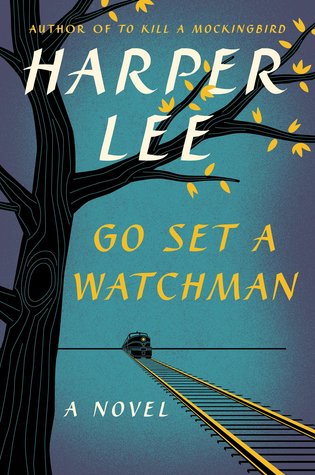
Go Set a Watchman by Harper Lee

Go Set a WatchmanGo Set a Watchman by Harper Lee

      As a 9th grade English teacher, I felt it my duty to expedite my reading and critique of this controversial blockbuster. Surprisingly enough, I enjoyed it but not for the same reasons I enjoyed Lee's masterpiece To Kill a Mockingbird.  Things loved about Mockingbird are its seamless Southern Gothic prose; strong cast of characters and heroes; and the plot's complex treatment of themes of prejudice, coming of age, and justice in an unjust world. If you are looking for these elements outright in Watchmen, you will not find them, or rather, you will find the underdeveloped seeds of them.

Instead, in Watchman, you will find twenty-six-year-old Jean Louise Finch returning home from New York City (I missed what she does there?) to visit Maycomb.  Upon arrival Jean Louise is already conflicted about whether or not she intends to someday marry Henry 'Hank' Clinton, the neighborboy from across the street whom Atticus has taken under his wing.  Just as brave and brazen as before, Jean Louise immediately finds trouble when she steps into a council meeting where her father seems to be playing a key role in navigating th "civil rights problem."  Will Jean Louise come to terms with her past and reconcile the pure adoration she once felt for her father now that she realizes even Atticus isn't morally perfect?

     I read Watchmen as a prequel rather than its chronological sequel. This is because Harper Lee wrote this manuscript first, met with an editor, and then wrote Mockingbird. Thus, as a writer, it was  more interesting to read this new book thinking about how Harper Lee worked backwards to arrive at her masterpiece. This was also a lot more fulfilling than endlessly comparing and contrasting the two works to find Watchman's shortcomings.

    Jean Louise's Uncle Jack Finch is a hero in this book, and bestows upon her some grand nuggets of wisdom : “it’s always easy to look back and see what we were, yesterday, ten years ago. It is hard to see what we are. If you can master that trick, you’ll get along.”

Tuesday, July 7, 2015

Review of Kohn's "Punished by Rewards"

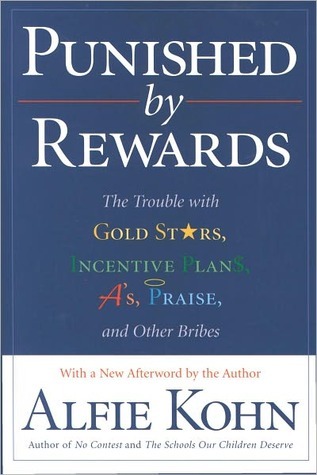
Punished by Rewards: The Trouble with Gold Stars, Incentive Plans, A's, Praise, and Other Bribes I read Alfie Kohn’s Punished by Rewards: The Trouble with Gold Stars, Incentive Plans, A's, Praise, and Other Bribes which debunks the myth that rewards and punishments can effectively control and change human behavior. Kohn builds his argument by dismantling America’s love affair with“pop behaviorism,” which Arthur Koestler, author of The Act of Creation, describes as “For the anthropomorphic view of the rat, American psychology substituted a rattomoprhic view of man” (3). One of the most important ideas of the book is after reviewing years of surprising research, Kohn illustrates how “carrots and sticks” have detrimental effects on workers’ and students’ performance and motivation, which seems counterintuitive to the popular belief. Kohn cites countless studies of elementary schoolers to college students and adults that show how rewards for completing tasks can singlehandedly annihilate quality,  creativity and risk-taking. Throughout the book, Kohn presents this argument with a multitude of examples which he organizes in three contexts: the workplace, the school system, and parenting. A second important idea from this book is Kohn’s argument that praise is just as detrimental to motivation as tangible rewards and punishments. Kohn asserts, “We tell [students] how good they are and they light up, eager to please, and try to please us some more. There are the children we should really worry about” (104). This struck me as particularly eye-opening because I was one of those kids, and I am a PBIS teacher who is constantly trying to use more praise in my classroom!  A third important idea from this book includes  Kohn’s alternatives to using rewards and punishments. Kohn calls these alternatives “The Three Cs: Content, Collaboration, and Choice,” content meaning providing students with a genuine purpose and “compelling why” for what we do in the classroom, collaborationmeaning true learning happening with what we do together rather than the control teachers use to “manage students,” and choice meaning the importance of providing real and meaningful choice and students' control in the classroom.  Overall, this book really got me thinking about how to use more specific feedback of my observations of students instead of simply praising them, as well how I can possibly implement more standards-based grading practices even though my school district is light years away from this shift. Lastly, this book has a lot of substantial evidence disproving the effects of merit pay, which is frustrating when our profession’s compensation is headed in that direction. I stronglying reccoomdent this book; this was a very thought-provoking and detailed read.