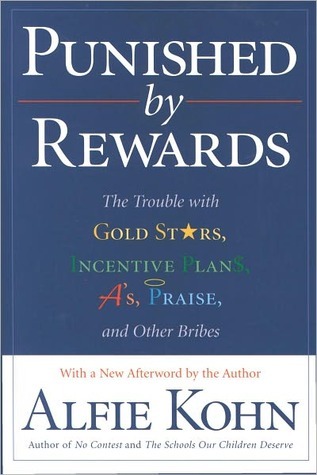
 I read Alfie Kohn’s Punished by Rewards: The Trouble with Gold Stars, Incentive Plans, A's, Praise, and Other Bribes which debunks the myth that rewards and punishments can effectively control and change human behavior. Kohn builds his argument by dismantling America’s love affair with“pop behaviorism,” which Arthur Koestler, author of The Act of Creation, describes as “For the anthropomorphic view of the rat, American psychology substituted a rattomoprhic view of man” (3). One of the most important ideas of the book is after reviewing years of surprising research, Kohn illustrates how “carrots and sticks” have detrimental effects on workers’ and students’ performance and motivation, which seems counterintuitive to the popular belief. Kohn cites countless studies of elementary schoolers to college students and adults that show how rewards for completing tasks can singlehandedly annihilate quality, creativity and risk-taking. Throughout the book, Kohn presents this argument with a multitude of examples which he organizes in three contexts: the workplace, the school system, and parenting. A second important idea from this book is Kohn’s argument that praise is just as detrimental to motivation as tangible rewards and punishments. Kohn asserts, “We tell [students] how good they are and they light up, eager to please, and try to please us some more. There are the children we should really worry about” (104). This struck me as particularly eye-opening because I was one of those kids, and I am a PBIS teacher who is constantly trying to use more praise in my classroom! A third important idea from this book includes Kohn’s alternatives to using rewards and punishments. Kohn calls these alternatives “The Three Cs: Content, Collaboration, and Choice,” content meaning providing students with a genuine purpose and “compelling why” for what we do in the classroom, collaborationmeaning true learning happening with what we do together rather than the control teachers use to “manage students,” and choice meaning the importance of providing real and meaningful choice and students' control in the classroom. Overall, this book really got me thinking about how to use more specific feedback of my observations of students instead of simply praising them, as well how I can possibly implement more standards-based grading practices even though my school district is light years away from this shift. Lastly, this book has a lot of substantial evidence disproving the effects of merit pay, which is frustrating when our profession’s compensation is headed in that direction. I stronglying reccoomdent this book; this was a very thought-provoking and detailed read.
Tuesday, July 7, 2015
Review of Kohn's "Punished by Rewards"
I read Alfie Kohn’s Punished by Rewards: The Trouble with Gold Stars, Incentive Plans, A's, Praise, and Other Bribes which debunks the myth that rewards and punishments can effectively control and change human behavior. Kohn builds his argument by dismantling America’s love affair with“pop behaviorism,” which Arthur Koestler, author of The Act of Creation, describes as “For the anthropomorphic view of the rat, American psychology substituted a rattomoprhic view of man” (3). One of the most important ideas of the book is after reviewing years of surprising research, Kohn illustrates how “carrots and sticks” have detrimental effects on workers’ and students’ performance and motivation, which seems counterintuitive to the popular belief. Kohn cites countless studies of elementary schoolers to college students and adults that show how rewards for completing tasks can singlehandedly annihilate quality, creativity and risk-taking. Throughout the book, Kohn presents this argument with a multitude of examples which he organizes in three contexts: the workplace, the school system, and parenting. A second important idea from this book is Kohn’s argument that praise is just as detrimental to motivation as tangible rewards and punishments. Kohn asserts, “We tell [students] how good they are and they light up, eager to please, and try to please us some more. There are the children we should really worry about” (104). This struck me as particularly eye-opening because I was one of those kids, and I am a PBIS teacher who is constantly trying to use more praise in my classroom! A third important idea from this book includes Kohn’s alternatives to using rewards and punishments. Kohn calls these alternatives “The Three Cs: Content, Collaboration, and Choice,” content meaning providing students with a genuine purpose and “compelling why” for what we do in the classroom, collaborationmeaning true learning happening with what we do together rather than the control teachers use to “manage students,” and choice meaning the importance of providing real and meaningful choice and students' control in the classroom. Overall, this book really got me thinking about how to use more specific feedback of my observations of students instead of simply praising them, as well how I can possibly implement more standards-based grading practices even though my school district is light years away from this shift. Lastly, this book has a lot of substantial evidence disproving the effects of merit pay, which is frustrating when our profession’s compensation is headed in that direction. I stronglying reccoomdent this book; this was a very thought-provoking and detailed read.

Subscribe to:
Post Comments (Atom)
No comments:
Post a Comment